Topic 8: Inventory Model: Inventory Control Policies and Stochastic Inventory Models
05115130 Supply Chain Modelling and Optimisation
12 Jun 2026
Outline
- EOQ Reorder Point Review
- 1.1 Basic EOQ and ROP
- 1.2 Worked Example: Carpet Store
- 1.3 Service-Level Intuition (bridge from stochastic models)
- Continuous Review (Q, R) System
- 2.1 Constant demand & constant lead time
- 2.2 Variable demand & constant lead time
- 2.3 Constant demand & variable lead time
- 2.4 Variable demand & variable lead time
- Periodic Review (P) System
- 3.1 Basic mechanics and order-up-to level
- 3.2 Worked Example: Bird Feeder Company
- Choosing Between Q and P
- 4.1 Comparison and decision rules
- 4.2 Summary and key formulas
- Single-Period Normal-Demand Model (Newsvendor)
- 5.1 Critical ratio and optimal order quantity
- 5.2 Expected cost under normal demand
- 5.3 Worked example and interpretation
1. EOQ Reorder Point Review
Goal: Decide how much to order and when to order.
- EOQ gives order size; ROP gives order timing.
\[ \boxed{ROP = d \times L} \]
where \(d\) is demand rate and \(L\) is lead time.
1.1 Basic EOQ and ROP
For annual demand \(D\), ordering cost \(K\), and annual holding cost \(h\):
\[ \boxed{Q^* = \sqrt{\frac{2KD}{h}}} \]
- \(Q^*\) optimal batch size to minimise total cost.
- EOQ does not include safety stock; it is the ideal order quantity under deterministic assumptions.
Then,
\[ ROP = d \times L \]
- \(ROP\) protects demand during replenishment lead time.
What happens if lead time doubles?
1.2 Worked Example: Carpet Store
The carpet store wants to determine the optimal order size and total inventory cost given an estimated demand of 10,000 yards of carpet, an annual carrying cost of $0.75 per yard, and an ordering cost of $150. The store would also like to know the number of orders that will be made annually and the time between orders (i.e., the order cycle) given that the store is open 311 days per year. The lead time to receive an order is 10 days, determine the reorder point for carpet.
Given:
- \(D = 10{,}000\) yards/year
- \(K = 150\) dollars/order
- \(h = 0.75\) dollars/yard/year
- Store open 311 days/year
- Lead time \(L = 10\) days
Compute EOQ:
\[ Q^* = \sqrt{\frac{2(150)(10000)}{0.75}} \approx 2000\ \text{yards} \]
- Orders per year:
\[ n = \frac{D}{Q^*} = \frac{10000}{2000} = 5 \]
- Order cycle length:
\[ T = \frac{311}{5} \approx 62.2\ \text{days} \]
- Demand rate per day and reorder point:
\[ d = \frac{10000}{311} \approx 32.15, \quad ROP = dL \approx 32.15(10) \approx 322\ \text{yards} \]
1.3 Service-Level Intuition (Bridge)
When demand is uncertain, use safety stock:
\[ \boxed{ROP = \bar{d}L + SS}, \quad \boxed{SS = z\sigma_L} \]
- \(z\) corresponds to target cycle-service level.
- Typical values: 90% (\(z \approx 1.28\)), 95% (\(z \approx 1.645\)), 99% (\(z \approx 2.33\)).
- Higher service level means more safety stock and higher holding cost.
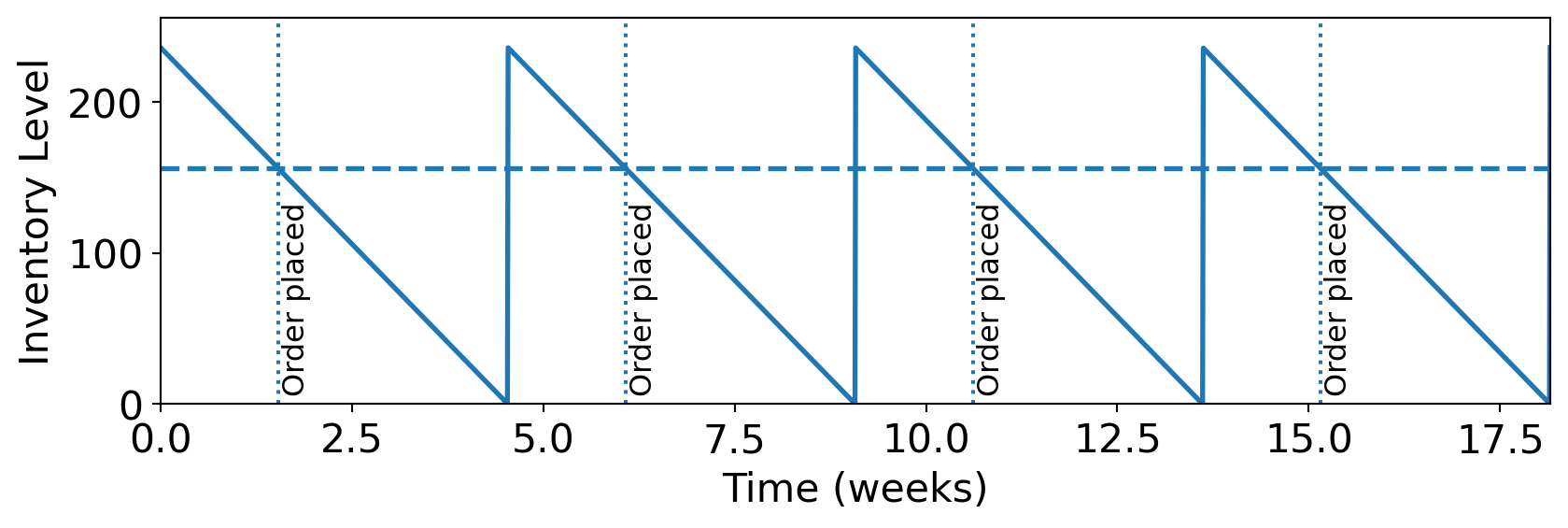
2. Continuous Review (Q, R) System
- Inventory position is monitored continuously.
- Place an order of fixed size \(Q\) when inventory reaches \(R\).
- Main strengths:
- responsive to demand changes,
- lower average inventory for similar service levels.
We will cover four cases:
Constant demand & constant lead time
Variable demand & constant lead time
Constant demand & variable lead time
Variable demand & variable lead time
2.1 Constant Demand and Constant Lead Time
If demand and lead time are both stable:
\[ \boxed{R = dL} \]
Example: \(d = 100\) units/week and\(L = 2\) weeks
\[ R = 100(2) = 200\ \text{units} \]
- Interpretation: place order whenever inventory position hits 200.
This works as the deterministic baseline policy.
2.2 Variable Demand and Constant Lead Time
With uncertain demand and fixed lead time:
\[ \boxed{ROP = \bar{d}L + SS} \]
\[ \boxed{SS = z\sigma_L}, \quad \boxed{\sigma_L = \sigma_d\sqrt{L}} \]
where:
- \(\bar{d}\) is average demand rate during lead time.
- \(\sigma_d\) is standard deviation of demand per time unit.
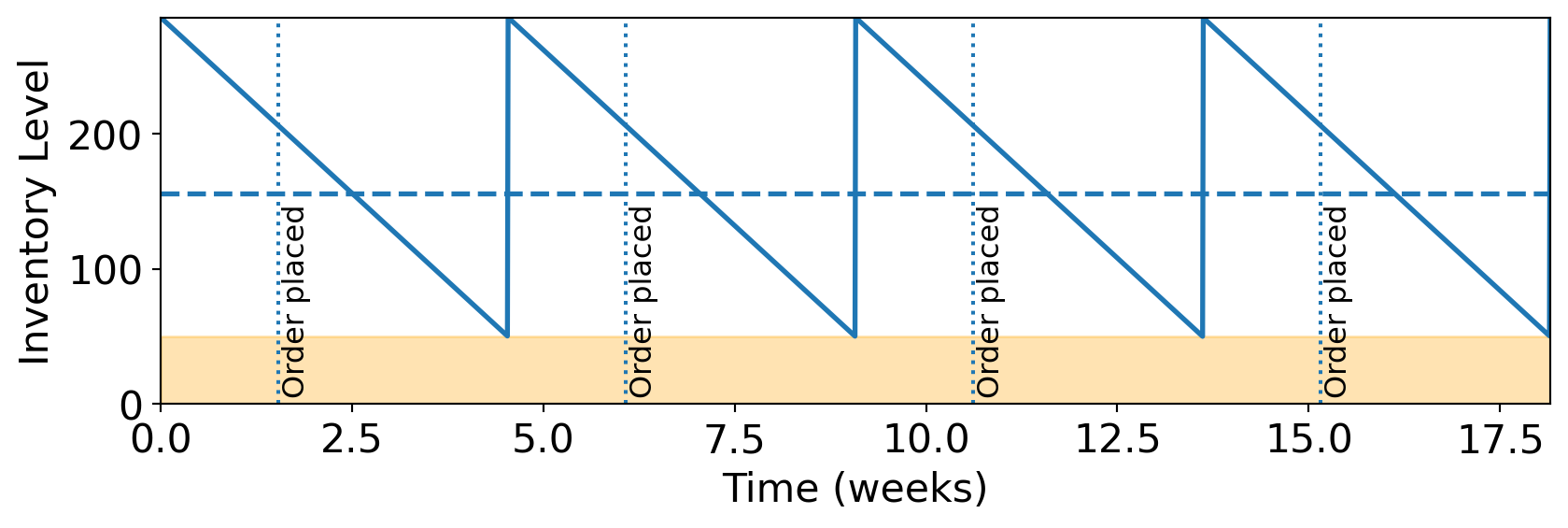
- \(\bar{d}L\) covers expected lead-time demand.
- \(SS\) buffers demand variability during lead time.
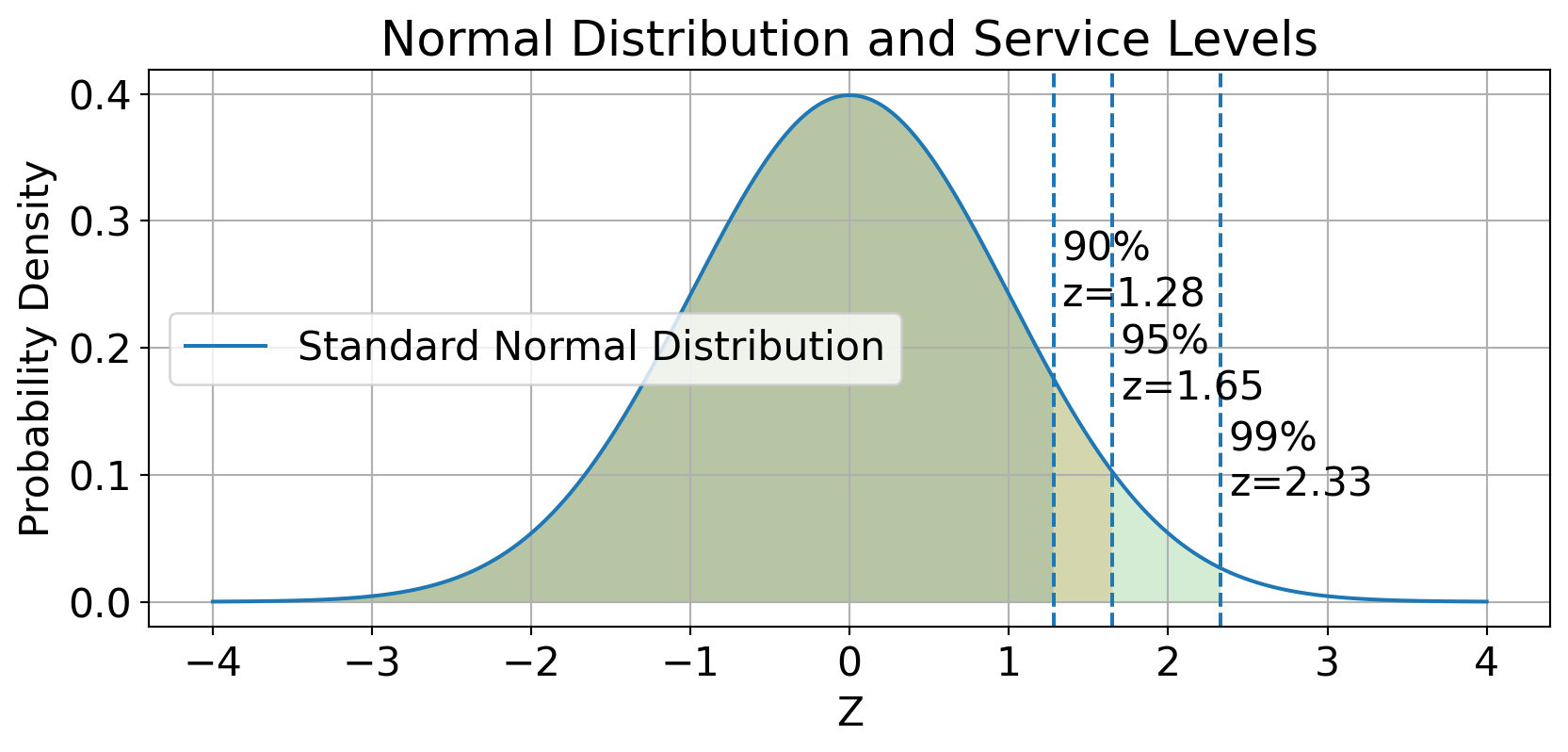
- \(z\) corresponds to the desired service level.
- \(z\) corresponds to the desired service level.
- Higher \(z\) means more safety stock and higher service level.
- The value of \(z\) can be found from standard normal distribution tables based on the target service level (e.g., 1.28 for 90%, 1.645 for 95%, 2.33 for 99%).
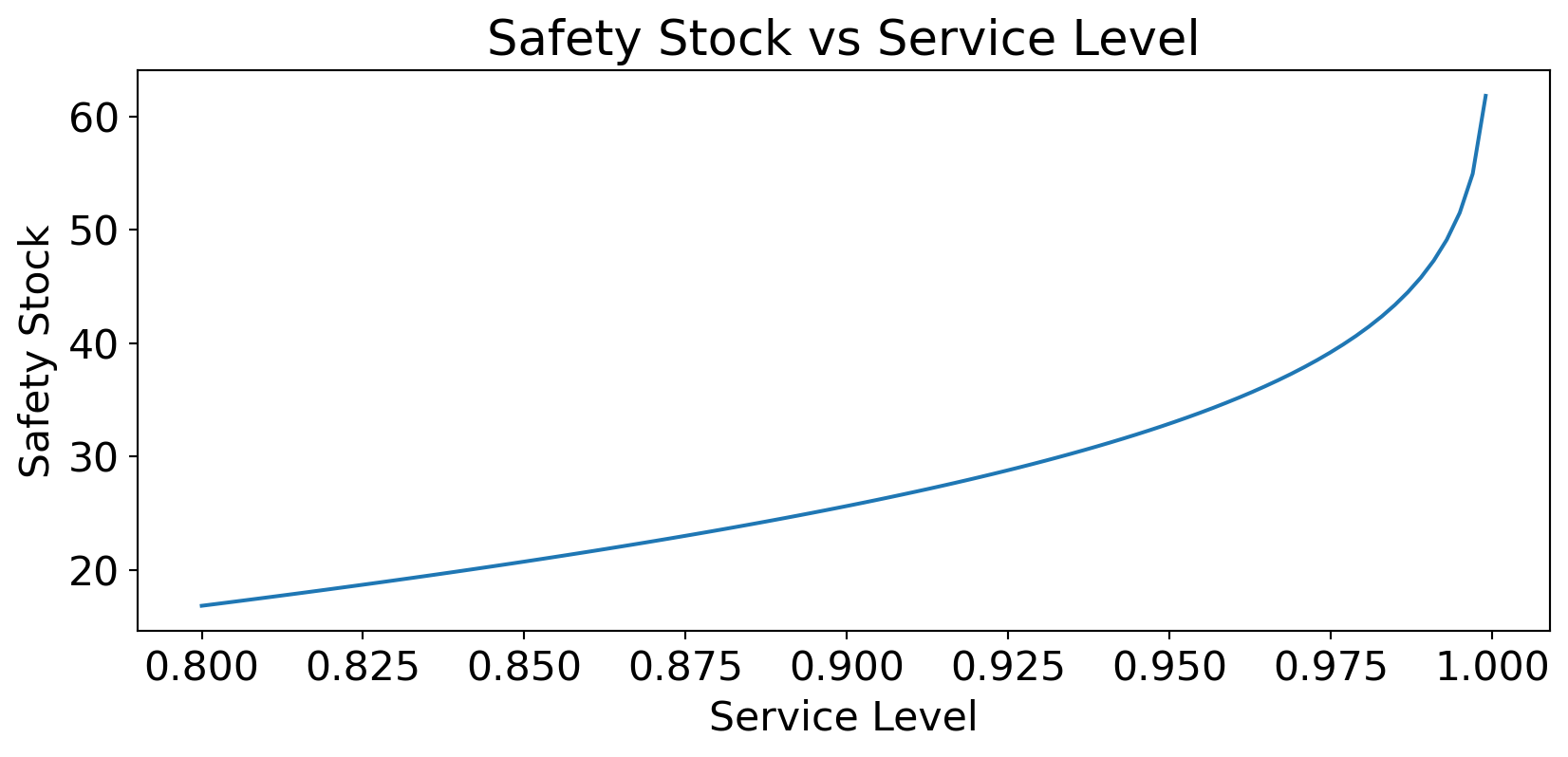
- The relationship between service level and safety stock is nonlinear.
- As service level approaches 100%, the required safety stock increases dramatically.
- This is because the tail of the normal distribution becomes thinner, requiring more inventory to cover rare demand spikes.
2.2 Worked Example: Bird Feeders
Suppose that the average demand for bird feeders is 18 units per week with a standard deviation of 5 units. The lead time is constant at 2 weeks. Determine the safety stock and reorder point for a 90 percent cycle-service level.
- \(\bar{d} = 18\) units/week
- \(\sigma_d = 5\) units/week
- \(L = 2\) weeks
- Service level = 90%, so \(z = 1.28\)
Compute lead-time demand deviation:
\[ \sigma_L = 5\sqrt{2} \approx 7.07 \]
Safety stock at 90% service level:
\[ SS = 1.28(7.07) \approx 9 \text{units} \]
Reorder point:
\[ ROP = \bar{d}L + SS = 18(2) + 9 \approx 45 \text{units} \]
2.2 Worked Example: Supermarket Milk Inventory
A supermarket sells milk and wants to avoid running out while waiting for new deliveries. Given
- Average demand = 200 cartons per week
- Delivery lead time = 3 weeks
- Demand variability = ±20 cartons/week
- Desired service level = 95% (very low chance of stockout)
Determine safety stock and reorder point.
From the problem statement:
- \(\bar{d} = 200\) cartons/week
- \(\sigma_d = 20\) cartons/week
- \(L = 3\) weeks
- Service level = 95%, so \(z = 1.645\)
Compute lead-time demand deviation:
\[ \sigma_L = 20\sqrt{3} \approx 34.64 \]
Safety stock at 95% service level:
\[ SS = 1.645(34.64) \approx 57 \]
Reorder point:
\[ ROP = \bar{d}L + SS = 200(3) + 57 = 657\ \text{cartons} \]
Policy statement:
- Monitor continuously.
- Place fixed order quantity \(Q\) when inventory position reaches 657.
What happens to SS if service target goes to 99%?
2.3 Constant Demand and Variable Lead Time
If demand is stable but lead time varies:
\[ \boxed{R = d\bar{L} + SS}, \quad \boxed{SS = zd\sigma_{LT}} \] where:
- \(\bar{L}\) is average lead time.
- \(\sigma_{LT}\) is standard deviation of lead time.
Example: A store sells about 10 digital cameras a day. Lead time For camera delivery is normally distributed with a mean time of 6 days and a standard deviation of 3 days. A 95% service level is set. Find the reorder point.
- \(d = 10\) units/day
- \(\bar{L} = 6\) days
- \(\sigma_{LT} = 3\) days
- 95% service so \(z = 1.645\)
\[ R = 10(6) + 1.645(10)(3) = 109.35 \approx 109 \]
2.4 Variable Demand and Variable Lead Time
When both demand and lead time are variable:
\[ \boxed{ROP = \bar{d}\bar{L} + SS}, \qquad \boxed{SS = z\sqrt{\bar{L}\sigma_d^2 + \bar{d}^2\sigma_L^2}} \]
- Sometimes written as \(SS = z\sigma_{dL}\) where \(\sigma_{dL}\) is the combined standard deviation of demand during lead time.
Example: A store’s most popular item is 9-volt battery. About 150 batteries are sold per day, following a normal distribution with a standard deviation of 16 batteries. Batteries are ordered from an out-of-state distributor; lead time is normally distributed with an average of 5 days a standard deviation of 1 day. To maintain a 95% service level, what ROP is appropriate?
- \(\bar{d}=150\), \(\sigma_d=16\) (units/day)
- \(\bar{L}=5\), \(\sigma_L=1\) (days)
- 95% service, \(z=1.645\)
Compute combined deviation:
\[ \sigma_{dL} = \sqrt{5(16)^2 + (150)^2(1)^2} \approx 154 \]
Safety stock:
\[ SS = 1.645(154) \approx 253 \]
Reorder point:
\[ ROP = 150(5) + 253 \approx 1003\ \text{units} \]
Exercise: Grey Wolf Lodge is a popular 500-room hotel in the North Woods. Managers need to keep close tabs on all room service items, including a special pine-scented bar soap. The daily demand for the soap is 275 bars, with a standard deviation of 30 bars. Ordering cost is $10 and the inventory holding cost is $0.30/bar/year. The lead time from the supplier is 5 days, with a standard deviation of 1 day. The lodge is open 365 days a year.
- What is the economic order quantity for the bar of soap?
- What should the reorder point be for the bar of soap if management wants to have a 99 percent cycle-service level?
- What is the total annual cost for the bar of soap, assuming a Q system will be used?
- Given:
- \(D=275 \times 365\), \(K=10\), \(h=0.30\),
- \(\bar{d}=275\), \(\sigma_d=30\), \(\bar{L}=5\), \(\sigma_L=1\),
- service level = 99% so \(z=2.33\).
EOQ \[ Q^* = \sqrt{\frac{2KD}{h}} = \sqrt{\frac{2(10)(275 \times 365)}{0.30}} \approx 2,587\ \text{bars} \]
Reorder point: \[ \begin{aligned} ROP &= \bar{d}\bar{L} + z\sqrt{\bar{L}\sigma_d^2 + \bar{d}^2\sigma_L^2} \\ &= 275(5) + 2.33\sqrt{5(30)^2 + (275)^2(1)^2} \\ &\approx 2,035\ \text{bars} \end{aligned} \]
Total annual cost: \[ \begin{aligned} TC &= \frac{D}{Q^*}K + \left(\frac{Q^*}{2} + SS\right)h \\ &= 388 + 586 \\ &\approx \$974.06 \end{aligned} \]
3. Periodic Review (P) System
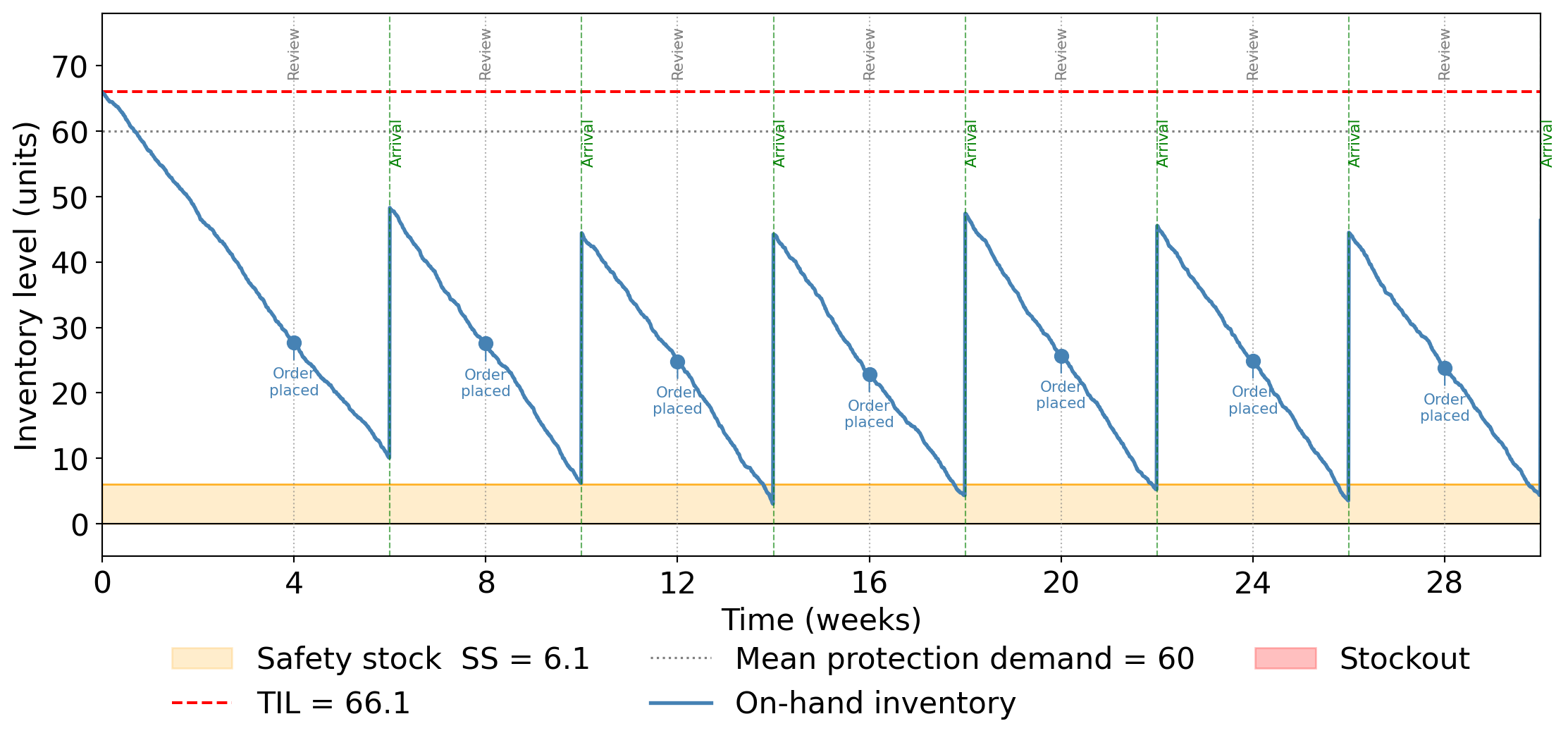
| Feature | Description |
|---|---|
| Review Interval \((P)\) | Orders are placed every \(P\) periods (e.g., every 4 weeks). |
| Order Quantity \((Q)\) | Varies each cycle; depends on how much is needed to “top up” to a target inventory level. |
| Target Inventory Level \((TIL)\) | A pre-set level that the inventory should reach after each order. |
| Lead Time \((L)\) | Time taken for the order to arrive after it’s placed. |
| Safety Stock \((SS)\) | Extra stock to cover demand variability during the protection period = \((P + L)\). |
Core idea
\[ \text{Order quantity} = TIL - \text{inventory position at review} \]
3.1 Basic Mechanics and Order-Up-To Level
For a Periodic Review System with review period \((P)\), average demand \((\bar d)\), average lead time \((\bar L)\), demand standard deviation per unit time \((\sigma_d)\), lead-time standard deviation \((\sigma_L)\), and service factor \((z)\):
| Case | Safety Stock (SS) | Order-Up-To Level (TIL) |
|---|---|---|
| No uncertainty | \(0\) | \(\boxed{TIL=d(P+L)}\) |
| Demand uncertainty | \(\boxed{SS=z\sigma_d\sqrt{P+L}}\) | \(\boxed{TIL=\bar d(P+L)+z\sigma_d\sqrt{P+L}}\) |
| Lead time uncertainty | \(\boxed{SS=zd\sigma_L}\) | \(\boxed{TIL=d(P+\bar L)+zd\sigma_L}\) |
| Demand + lead time uncertainty | \(\boxed{SS=z\sqrt{\sigma_d^2(P+\bar L)+\bar d^2\sigma_L^2}}\) | \(\boxed{TIL=\bar d(P+\bar L)+z\sqrt{\sigma_d^2(P+\bar L)+\bar d^2\sigma_L^2}}\) |
If using the EOQ-based optimal review period \(\boxed{T=\frac{Q^*}{\bar d}=\sqrt{\frac{2K}{\bar d h}}}\)
then simply replace \(P\) with \(T\): \(\boxed{I_{\max}=TIL}\)
| Case | Maximum Inventory Level \(I_{\max}\) |
|---|---|
| No uncertainty | \(\boxed{\bar d(T+\bar L)}\) |
| Demand uncertainty only | \(\boxed{\bar d(T+\bar L)+z\sigma_d\sqrt{T+\bar L}}\) |
| Lead time uncertainty only | \(\boxed{\bar d(T+\bar L)+z\bar d\sigma_L}\) |
| Demand + lead time uncertainty | \(\boxed{\bar d(T+\bar L)+z\sqrt{\sigma_d^2(T+\bar L)+\bar d^2\sigma_L^2}}\) |
\[ \text{TIL}=\text{Expected demand during protection period}+\text{Safety stock} \]
where the protection period is \(\boxed{P+\bar L}\).
(or \(T+\bar L\) when using the EOQ-derived review period).
3.2 Worked Example: Bird Feeder Company
A bird feeder company uses a periodic review (\(P\)) inventory system. Weekly demand is normally distributed with an average of 30 units and a standard deviation of 10 units. The supplier lead time is 2 weeks, and the company operates year-round (52 weeks annually). The system specifies an EOQ of 75 units and maintains safety stock to achieve a 95% cycle-service level. Determine the review period \(P\) and the targeted inventory level \(TIL\) for this system.
- Review period \(P\)
- Given EOQ = 75 units, average period demand \(\bar{d}=30\;\) units
- \(\displaystyle P = \frac{EOQ}{\bar{d}} = \frac{75}{30} = 2.5\;\) weeks
- Targeted inventory level \(TIL\)
- \(SS = z \sigma_d \sqrt{P+L} = (1.645)(10)(\sqrt{2.5+2}) =34.8957\quad\) units
- \(TIL= \bar{d} \times (P+L) + SS = (30)(2.5+2) + 34.8957=169.8957\quad\) units
4. Choosing Between Q and P
- Both systems use service level and safety stock ideas.
- Main design difference is review cadence and order quantity behavior.
- Selection should reflect data quality, IT capability, and operational rhythm.
| Feature | Continuous (Q, R) | Periodic (P) |
|---|---|---|
| Review frequency | Continuous | Every \(P\) time units |
| Order size | Fixed (\(Q\)) | Variable |
| Reorder trigger | Inventory position reaches \(R\) | Scheduled review |
| Typical safety stock | Lower | Higher |
| Monitoring effort | Higher | Lower |
Decision rules
- Use Q-system for high-value or critical items.
- Use P-system when orders are synchronised on fixed schedules.
- Takeaway: EOQ sets size, ROP/TIL set timing and protection.
5. Single-Period Normal-Demand Model (Newsvendor)
Motivation
- The newsvendor model is a classic framework for inventory decisions when demand is uncertain and the selling season is short. It applies to products that have a single selling period, such as newspapers, fashion items, or perishable goods.
- The key decision is how many units to order before the selling period begins, given that demand is random and that unsold inventory may have a salvage value, while unmet demand results in lost sales.
- The model helps determine the optimal order quantity that minimizes expected costs or maximises expected profit, taking into account the trade-offs between ordering too much (overage) and ordering too little (underage).
- Normal demand is often assumed for analytical tractability, allowing us to derive closed-form solutions for the optimal order quantity.
5.1 Critical Ratio and Optimal Order Quantity
Define costs:
\[ \boxed{C_o = c-u} \quad \boxed{C_u = r-c} \]
where
- \(C_o\) is the overage cost per unit (cost minus salvage value).
- \(C_u\) is the underage cost per unit (selling price minus cost).
Critical ratio
\[ \boxed{CR = \frac{C_u}{C_u + C_o} = \frac{r-c}{r-u}} \]
This represents the relative cost of understocking versus overstocking.
Higher \(CR\) means understocking is more costly, so you want to order more.
Lower \(CR\) means overstocking is more costly, so you want to order less
Optimal order rule
\[ \boxed{P(D \le Q^*) = CR} \]
- This means you should choose the order quantity \(Q^*\) such that the probability of demand being less than or equal to \(Q^*\) equals the critical ratio.
- For normal demand \(D \sim N(\mu,\sigma)\):
\[ Q^* = \mu + z\sigma \quad \text{where } \Phi(z)=CR \]
- \(\Phi(z)\) is the cumulative distribution function of the standard normal distribution, so you can find \(z\) from standard normal tables based on the critical ratio.
5.2 Expected Cost Under Normal Demand
For policy evaluation, we can compute the expected total cost for any order quantity \(Q\).
Expected total cost for order quantity \(Q\)
\[ \boxed{E[TC(Q)] = C_oE[(Q-D)^+] + C_uE[(D-Q)^+]} \]
With \(z = \frac{Q-\mu}{\sigma}\) and \(D\sim N(\mu,\sigma)\):
\[ E[(Q-D)^+] = \sigma[\phi(z)+z\Phi(z)] \qquad \text{(Expected leftover inventory cost)} \]
\[ E[(D-Q)^+] = \sigma[\phi(z)-z(1-\Phi(z))] \qquad \text{(Expected shortage cost)} \]
- \(\phi(z)\) is the standard normal density
- \(\Phi(z)\) is the standard normal cumulative distribution function
5.3 Worked Example: Normal-Demand Seasonal Product
- Selling price \(r=10\), purchase cost \(c=8\), salvage value \(u=5\)
- Demand \(D\sim N(\mu=500,\sigma=100)\)
Step 1: critical ratio
\[ CR = \frac{r-c}{r-u} = \frac{10-8}{10-5}=0.4 \]
Step 2: find \(z\) such that \(\Phi(z)=0.4\).
Using normal tables, \(z\approx -0.253\).
Step 3: compute optimal order
\[ Q^* = \mu + z\sigma = 500 + (-0.253)(100) \approx 475 \]
- optimal order is below mean demand because overage cost exceeds underage cost.