Tutorial 4 Solutions
This tutorial focuses on network design under uncertainty. The exercises are designed to help students understand the concepts and techniques related to making strategic decisions in supply chain management when faced with uncertain demand, supply, and other factors.
Question 1
A food distribution company must decide how to procure cold storage space for the next 2 years. It has three options:
- Option 1: Purchase all cold storage space as needed from the spot market.
- Option 2: Sign a 2-year fixed contract to lease a predetermined amount of storage, and fulfil any extra need through the spot market.
- Option 3: Sign a flexible-use lease, which includes a minimum committed space and allows expansion up to a cap, with excess paid at spot prices.
Information:
- Cold storage requirement: 1 sq.ft. per 500 frozen items.
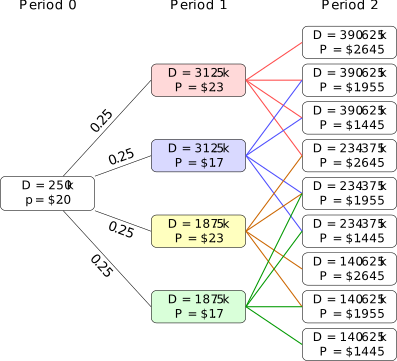
- Expected base demand: 250,000 frozen items per year.
- Demand may rise or fall by 25% annually with equal probability (0.5).
- Spot market price: $2.00/sq.ft/year, may rise or fall by 15%, also with equal probability.
- Fixed lease price: $1.75/sq.ft/year
- Revenue: $2.50 per frozen item
- Flexible lease of $20,000 upfront:
- Covers up to 250,000 items (i.e., 500 sq.ft).
- Charged at $1.75/sq.ft.
- Additional needs paid at spot price.
- Spot price and demand are independent.
- Discount rate k = 8%
Tasks:
- List all possible combinations of demand and spot prices.
- Calculate total storage needs (in sq.ft) for each demand level.
- Compute annual profit under each option across all scenarios.
- Calculate expected NPV over the 2-year period for each option.
- Determine the best option using decision tree logic (Bellman’s Principle).
Decision Tree
Option 1
The cost function for option 1 (obtain warehouse space from the spot market) is:
\[ \text{Cost} = \lceil D/500 \rceil \times P, \]
where \(D\) is the demand and \(P\) is the spot price. The function \(\lceil \cdots \rceil\) denotes the ceiling function, which rounds up to the nearest integer. The profit (payoff) is:
\[ \text{Profit} = \text{Revenue} - \text{Cost} \]
where the revenue is:
\[ \text{Revenue} = D \times 2.5 \]
| D | P | Revenue | Cost | Payoff | EV |
|---|---|---|---|---|---|
| 390625 | 2.645 | 976562.50 | 2068.39 | 974494.11 | 243623.53 |
| 390625 | 1.955 | 976562.50 | 1528.81 | 975033.69 | 243758.42 |
| 390625 | 1.445 | 976562.50 | 1129.99 | 975432.51 | 243858.13 |
| 234375 | 2.64 | 585937.50 | 1240.51 | 584697.00 | 146174.25 |
| 234375 | 1.955 | 585937.50 | 916.90 | 585020.61 | 146255.15 |
| 234375 | 1.445 | 585937.50 | 677.71 | 585259.80 | 146314.95 |
| 140625 | 2.645 | 351562.50 | 745.89 | 350816.61 | 87704.15 |
| 140625 | 1.955 | 351562.50 | 551.31 | 351011.19 | 87752.80 |
| 140625 | 1.445 | 351562.50 | 407.49 | 351155.01 | 87788.75 |
| D | P | \(EMV_2\) | \(PV_1\) | Revenue | Cost | Payoff | EV |
|---|---|---|---|---|---|---|---|
| 312500 | 2.3 | 779811.35 | 722047.55 | 781250 | 1437.50 | 1501860.05 | 375465.00 |
| 312500 | 1.7 | 780186.65 | 722395.05 | 781250 | 1062.50 | 1502582.55 | 375645.60 |
| 187500 | 2.3 | 467886.35 | 433228.10 | 468750 | 862.50 | 901115.60 | 225278.90 |
| 187500 | 1.7 | 468111.65 | 433436.71 | 468750 | 637.50 | 901549.21 | 225387.30 |
| D | P | \(EMV_1\) | \(PV_0\) | Revenue | Cost | NPV |
|---|---|---|---|---|---|---|
| 250000 | 2 | 1201776.85 | 1112756.34 | 625000 | 1000 | 1736756.34 |
Option 2
The cost function for option 2 (fixed contract for 250,000 items and spot market for excess) is:
\[ 500 \times 1.75 + \max(0, \lceil(D-250000)/500\rceil) \times P, \]
The profit (payoff) is calculated in the same way as option 1.
| D | P | Revenue | Cost | Payoff | EV |
|---|---|---|---|---|---|
| 390625 | 2.645 | 976562.50 | 2068.39 | 974494.11 | 243623.53 |
| 390625 | 1.955 | 976562.50 | 1528.81 | 975033.69 | 243758.42 |
| 390625 | 1.445 | 976562.50 | 1129.99 | 975432.51 | 243858.13 |
| 234375 | 2.645 | 585937.50 | 1240.51 | 584697.00 | 146174.25 |
| 234375 | 1.955 | 585937.50 | 916.90 | 585020.61 | 146255.15 |
| 234375 | 1.445 | 585937.50 | 677.71 | 585259.80 | 146314.95 |
| 140625 | 2.645 | 351562.50 | 745.89 | 350816.61 | 87704.15 |
| 140625 | 1.955 | 351562.50 | 551.31 | 351011.19 | 87752.80 |
| 140625 | 1.445 | 351562.50 | 407.49 | 351155.01 | 87788.75 |
| D | P | \(EMV_2\) | \(PV_1\) | Revenue | Cost | Payoff | EV |
|---|---|---|---|---|---|---|---|
| 312500 | 2.3 | 780050.70 | 722269.17 | 781250 | 1162.50 | 1502356.67 | 375589.20 |
| 312500 | 1.7 | 780135.30 | 722347.50 | 781250 | 1087.50 | 1502510.00 | 375627.50 |
| 187500 | 2.3 | 467875.00 | 433217.59 | 468750 | 875.00 | 901092.59 | 225273.10 |
| 187500 | 1.7 | 467875.00 | 433217.59 | 468750 | 875.00 | 901092.59 | 225273.10 |
| D | P | \(EMV_1\) | \(PV_0\) | Revenue | Cost | NPV |
|---|---|---|---|---|---|---|
| 250000 | 2 | 1201762.96 | 1112743.48 | 625000 | 875 | 1736868.48 |
Option 3
The cost function for option 3 with flexible lease is:
\[ \min(500, \lceil D/500 \rceil) \times 1.75 + \max(0, \lceil (D-250000)/500 \rceil) \times P. \]
The profit (payoff) is calculated in the same way as option 1.
| Demand | Spot Price | Revenue | Cost | Profit (Payoff) | EV |
|---|---|---|---|---|---|
| 390625 | 2.645 | 976562.50 | 1620.89 | 974941.61 | 243735.40 |
| 390625 | 1.955 | 976562.50 | 1426.31 | 975136.19 | 243784.05 |
| 390625 | 1.445 | 976562.50 | 1282.49 | 975280.01 | 243820.00 |
| 234375 | 2.645 | 585937.50 | 820.75 | 585116.75 | 146279.19 |
| 234375 | 1.955 | 585937.50 | 820.75 | 585116.75 | 146279.19 |
| 234375 | 1.445 | 585937.50 | 820.75 | 585116.75 | 146279.19 |
| 140625 | 2.645 | 351562.50 | 493.50 | 351069.00 | 87767.25 |
| 140625 | 1.955 | 351562.50 | 493.50 | 351069.00 | 87767.25 |
| 140625 | 1.445 | 351562.50 | 493.50 | 351069.00 | 87767.25 |
| D | P | \(EMV_2\) | \(PV_1\) | Revenue | Cost | Payoff | EV |
|---|---|---|---|---|---|---|---|
| 312500 | 2.3 | 780077.83 | 722294.28 | 781250 | 1162.50 | 1502381.78 | 375595.40 |
| 312500 | 1.7 | 780162.43 | 722372.62 | 781250 | 1087.50 | 1502535.12 | 375633.80 |
| 187500 | 2.3 | 468092.83 | 433419.33 | 468750 | 656.25 | 901513.08 | 225378.30 |
| 187500 | 1.7 | 468092.83 | 433419.33 | 468750 | 656.25 | 901513.08 | 225378.30 |
| D | P | \(EMV_1\) | \(PV_0\) | Revenue | Cost | NPV |
|---|---|---|---|---|---|---|
| 250000 | 2 | 1201985.76 | 1112949.78 | 625000 | 20875 | 1717074.78 |
Comparison and Discussion
| Option | NPV |
|---|---|
| Option 1 | 1,736,756.34 |
| Option 2 | 1,736,868.48 |
| Option 3 | 1,717,074.78 |
The option 2, fixed contract for 250,000 items and spot market for excess, has the highest positive NPV. So the company should opt with the fixed contract. However, the NPV for option 1 is not much lower and offer more flexibility. The company should decide based on their main objective whether to maximise NPV or flexibility.
Question 2
Moon Micro is a small manufacturer of servers that currently builds all of its products in Santa Clara, California. As the market for servers has grown dramatically, the Santa Clara plant has reached a capacity of 10,000 servers per year. Moon is considering two options to increase its capacity. The first option is to add 10,000 capacity units to the Santa Clara plant at an annualised fixed cost of $10,000,000 plus $500 labour per server. The second option is to have Molectron, an independent assembler, manufacture servers for Moon at a cost of $2,000 for each server (excluding raw materials cost). Raw materials cost $8,000 per server, and Moon sells each server for $15,000.
- Moon must make this decision over a two-year time horizon. During each year, D for Moon servers has an 80% chance of increasing 50% from the year before and a 20% chance of remaining the same. Molectron’s prices may also change.
- Molectron’s prices have a 50% chance of increasing 20% from the year before and a 50% chance of remaining the same as the year before.
- Molectron’s prices are fixed for the first year but have a 40% chance of increasing 25% in the second year and a 60% chance of remaining where they are.
Option 1
Information:
- Add 10,000 capacity units at Santa Clara
- Costs
- Annualised fixed cost = $10M/year
- Labour cost at $500/server
- Raw materials at $8000/server
- Revenue = $15k/server
If Moon chooses to add capacity, the $10M fixed cost is paid annually regardless of demand, and the variable cost is $8,500 per server (raw materials + labour). The cost function can be expressed as:
\[ \text{Cost} = 10000000 + 8500\min(D, 20000) \]
The revenue is calculated as:
\[ \text{Revenue} = 15000 \times \min(D, 20000). \]
Therefore, the profit (payoff) is:
\[ \begin{aligned} \text{Profit} &= \text{Revenue} - \text{Cost} \\ &= 6500 \times \min(D, 20000) - 10000000 \end{aligned} \]
---
config:
  echo: false
  layout: elk
  elk:
    mergeEdges: false
    nodePlacementStrategy: NETWORK_SIMPLEX
    edgeRoutingStrategy: LINEAR_SEGMENTS
    spacing:
      nodeNode: 45
      edgeNode: 25
      edgeEdge: 12
---

flowchart LR

%% ----- Period 0 -----
subgraph P0["Period 0"]
    A(["D = 10k"])
end

%% ----- Period 1 -----
subgraph P1["Period 1"]
    B(["D = 15k"])
    C(["D = 10k"])

end

%% ----- Period 2 -----
subgraph P2["Period 2"]
    F(["D = 22.5k"])
    G(["D = 15k"])
    H(["D = 10k"])

end

%% Transitions

A -->|"0.8"| B
A -->|"0.2"| C

B -->|"0.8"| F
B -->|"0.2"| G

C -->|"0.8"| G
C -->|"0.2"| H


%% Subgraph background (white)
style P0 fill:#ffffff,stroke:#ffffff
style P1 fill:#ffffff,stroke:#ffffff
style P2 fill:#ffffff,stroke:#ffffff

style B fill:#d1e7dd;
style C fill:#f8d7da;
style F fill:#fff3cd;
style G fill:#cfe2ff;
style H fill:#f8aa24;

classDef default stroke:#000000,color:#000000, fill:#ffffff;
Option 2
Information
- Outsourcing to Molectron
- Cost = $2,000/server + $8000/server for raw materials
- Same demand uncertainty as option 1
- Year 0 to Year 1: Molectron’s price goes up 20% or remain the same with equal probability.
- Year 1 to Year 2: Molectron’s price goes up 25% or remain the same with probability of 40% and 60%, respectively.
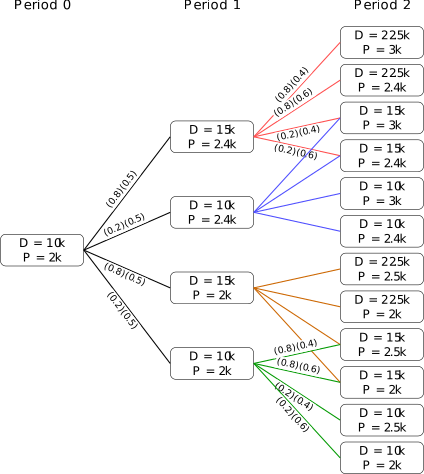
The cost function for option 2 is:
\[ \text{Cost} = \begin{cases} 8500D & \text{if } D \le 10000 \\ 8500(10000) + (8000 + P)(D-10000) & \text{if } D > 10000 \end{cases} \]
- If \(D \le 10000\), Moon uses existing capacity. Therefore, the cost is only for raw materials ($8,000/server) and labour ($500/server).
- If \(D > 10000\), Moon uses existing capacity up to 10,000 units and outsources the rest to Molectron. Therefore, the cost is the sum of the cost for 10,000 units produced in-house and the cost for outsourcing the excess demand to Molectron. The cost for outsourcing is the sum of raw materials cost ($8,000/server) and Molectron’s price ($P/server) multiplied by the excess demand (\(D\) - 10000).
Comparison and Discussion
| NPV | Option 1 (Expand) | Option 2 (Outsource) |
|---|---|---|
| Include P0 Profit | $243M | $258.168M |
| Exclude P0 Profit | $188M | $193.168M |
Option 2 is better based on expected NPV, because it gives the higher expected value under both treatments of Period 0. Therefore, Moon Micro should outsource to Molectron.
Question 3
Unipart, a manufacturer of auto parts, is considering two different B2B marketplaces to purchase its MRO supplies. Both marketplaces offer a full line of supplies for products and shipping at similar prices. Both provide very similar service levels and lead times. However, their fee structures are quite different. The first marketplace, Parts4u.com, sells all of its products with a 5% commission tacked on top of the price of the product (not including shipping).
- All MRO.com’s pricing is based on a subscription fee of $10 million that must be paid upfront for a two-year period and a commission of 1% on each transaction’s product price.
- Unipart spends about $150 million on MRO supplies yearly, although this varies with their utilisation. Next year will likely be a strong year, in which high utilisation will keep MRO spending at $150 million. However, there is a 25% chance that spending will drop by 10%. In the second year, there is a 50% chance that the spending level will stay where it was in the first year and a 50% chance that it will drop by another 10%.
- Unipart uses a discount rate of 20%.
- Assume all costs are incurred at the beginning of each year (so Year 1’s costs are incurred now, and Year 2 costs are incurred in a year).
Question 4
3COM is a server company with an annualised fixed cost of $2 million. As the market for servers has grown dramatically, its plant has reached a capacity of 10 thousand servers per year. 3com is considering adding 4 thousand units of capacity to the plant at an annualised fixed cost of $2.5 million. For each server, the production cost is $6,000, and the sales price is $10,000. During each year, demand for 3com servers has a 50% chance of increasing by 20% from the year before and a 50% chance of remaining the same as the year before. Production cost per server is fixed for the first year but has an 80% chance of increasing by 20% in the second year and a 20% chance of remaining the same as the year before. For a two-year time horizon, use a decision tree with a return rate of 0.1 to determine whether adding 4 thousand units or not adding of capacity to the plant is worthwhile if the lost sales cost per server is $1,000.